
Teacher-Led Instruction: A Comprehensive Overview (Updated 04/30/2026)
Teacher-led instruction, utilizing direct methods like explicit teaching and modeling, remains vital, especially when minimizing cognitive load for effective knowledge acquisition and retention.
What is Teacher-Led Instruction?
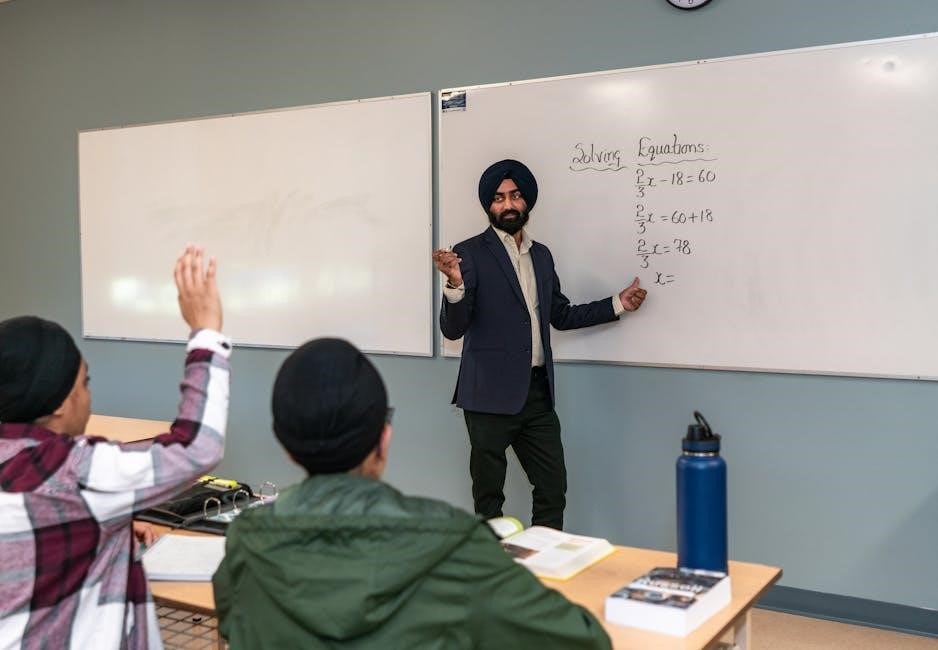
Teacher-led instruction represents an educational approach where the instructor maintains primary control over the learning process. This doesn’t necessarily equate to lecturing; rather, it involves the teacher directing activities, presenting information, and guiding students through a structured curriculum.
Historically, it’s been the dominant model, but modern interpretations emphasize a balance. Effective teacher-led instruction incorporates techniques like direct instruction, worked examples, and Socratic discussions – all facilitated by the teacher.
It’s about providing clear explanations, modeling problem-solving, and offering targeted support. While some perceive it as the opposite of learner-led approaches, it can be effectively integrated, particularly for foundational knowledge and minimizing extraneous cognitive load, especially in younger learners. The teacher acts as a ‘Guide’, offering mentorship and adapting to individual student needs.
Core Principles of Teacher-Led Instruction
Central to teacher-led instruction is the principle of explicit teaching – clearly articulating learning objectives and providing structured, step-by-step guidance. Another key tenet is efficient classroom management, maximizing instructional time and minimizing distractions.
Effective modeling, through worked examples and demonstrations, is crucial, allowing students to observe and learn problem-solving strategies.
Furthermore, a focus on minimizing extraneous cognitive load is paramount, ensuring students aren’t overwhelmed by unnecessary complexity. The teacher’s role is to scaffold learning, providing support that gradually diminishes as students gain competence. This approach prioritizes knowledge acquisition and a strong foundational understanding, while still allowing for guided practice and individualized support.
Historical Context of Teacher-Led Instruction
Historically, teacher-led instruction has been the dominant paradigm in education for centuries, rooted in the transmission of knowledge from expert to novice. This approach gained prominence with the rise of formal schooling systems, emphasizing standardized curricula and direct instruction.
While evolving pedagogical theories have introduced learner-centered approaches, the value of explicit teaching hasn’t diminished. Recent research reinforces the importance of strong guidance, particularly when addressing complex concepts or supporting students struggling with foundational skills.

The debate isn’t about abandoning teacher-led methods, but rather finding a balance – recognizing its continued relevance alongside more progressive techniques.

Benefits of Teacher-Led Instruction
Teacher-led instruction fosters enhanced knowledge acquisition, provides a structured learning environment, and efficiently utilizes classroom time through direct guidance and clear expectations.
Enhanced Knowledge Acquisition
Teacher-led instruction excels at delivering foundational knowledge efficiently. Explicit teaching, worked examples, and direct instruction minimize ambiguity, ensuring students grasp core concepts quickly. This approach is particularly beneficial when introducing complex topics, as it provides a clear framework for understanding.
By carefully sequencing information and providing targeted support, teachers can optimize knowledge acquisition. The structured nature of teacher-led lessons reduces cognitive overload, allowing students to focus on absorbing new material. Furthermore, the teacher’s ability to address misconceptions in real-time strengthens comprehension and promotes long-term retention. This contrasts with learner-led approaches where foundational gaps can easily emerge.
Structured Learning Environment
Teacher-led instruction inherently provides a highly structured learning environment. This predictability benefits many students, particularly those who thrive with clear expectations and routines. The teacher controls the pace, sequence, and scope of the lesson, minimizing distractions and maximizing focus. This structure is especially valuable for younger learners or those needing significant support.
A well-managed teacher-led classroom fosters a sense of order and discipline, creating a safe space for learning; This contrasts with more open-ended, learner-led environments which can sometimes lack the necessary boundaries for all students to succeed. The teacher’s guidance ensures all students are exposed to the same core content and skills.
Efficient Use of Classroom Time
Teacher-led instruction often leads to a more efficient use of classroom time. With the teacher directing the flow, there’s less time wasted on tangential discussions or unproductive activities. Lessons are carefully planned and paced to cover specific content within a defined timeframe. This focused approach is particularly crucial when preparing students for standardized assessments or covering a large curriculum.
Unlike learner-led approaches, which can be valuable but sometimes slower, teacher-led methods allow for direct knowledge transfer. The teacher can quickly address misconceptions and keep the class moving forward. This doesn’t preclude discussion, but it ensures that core concepts are prioritized and adequately addressed within the allotted time.
Comparison with Learner-Led Instruction
Teacher-led and learner-led instruction aren’t necessarily opposites; a balance integrating both approaches—direct instruction alongside student-driven exploration—often yields the most effective learning outcomes.
Key Differences: Teacher vs. Student Control
The core distinction between teacher-led and learner-led instruction lies in the locus of control. In teacher-led environments, the educator dictates the pace, content, and assessment methods, guiding students through a pre-determined curriculum. This contrasts sharply with learner-led approaches where students have significant autonomy in choosing what and how they learn.
However, it’s crucial to understand this isn’t a rigid dichotomy. Even within teacher-led frameworks, skilled educators incorporate student input and cater to individual needs. Conversely, even in learner-led settings, a guiding presence is essential to provide structure and support. The degree of control shifts along a spectrum, impacting student engagement and the depth of understanding achieved. Guides, as seen in schools like The Forest School, utilize mentorship and questioning rather than strict lecturing.
Debunking the “Opposites” Myth
The notion that teacher-led instruction and student-centered learning are mutually exclusive is a pervasive, yet inaccurate, belief. Effective pedagogy doesn’t necessitate choosing one over the other; instead, it involves strategically integrating both approaches. Dismissing teacher-led methods entirely overlooks the benefits of direct, explicit instruction, particularly in establishing foundational knowledge.
As highlighted by teacherhead, the disagreement isn’t about preference, but about recognizing the necessity of strong guidance. Weak guidance can overwhelm learners with extraneous cognitive load, hindering their ability to develop robust problem-solving skills. A balanced approach leverages the structure of teacher-led instruction alongside the engagement of learner-led exploration.
Finding a Balance: Integrating Both Approaches
Achieving optimal learning outcomes requires a dynamic interplay between teacher-led and learner-led strategies. Schools like The Forest School demonstrate this by initially employing direct instruction for younger students, gradually transitioning towards more student-driven methods around age seven. This phased approach acknowledges developmental readiness and builds a strong foundation.
The key lies in recognizing when each approach is most effective. Teacher-led instruction excels at introducing complex concepts and establishing core skills, while learner-led activities foster critical thinking and independent exploration. A skilled educator acts as a facilitator, seamlessly shifting between guidance and support, ensuring students are both informed and empowered.
Effective Techniques in Teacher-Led Instruction
Employing direct instruction, worked examples, case studies, and Socratic discussions—guided by the teacher—enhances comprehension and minimizes extraneous cognitive load for students.
Direct Instruction & Explicit Teaching

Direct instruction, a cornerstone of teacher-led approaches, emphasizes clearly defined learning objectives and a structured, sequential delivery of content. This method isn’t simply lecturing; it’s a carefully orchestrated process involving explicit modeling, guided practice, and independent practice.
Effective explicit teaching breaks down complex skills into smaller, manageable steps, ensuring students grasp each component before moving forward. Teachers actively demonstrate procedures, think aloud to reveal their reasoning, and provide immediate, corrective feedback.
This contrasts with discovery learning, where students are left to construct knowledge independently. Research suggests that direct instruction is particularly beneficial when introducing new concepts or skills, especially for students who may struggle with self-directed learning or have limited prior knowledge. It’s about providing strong guidance to avoid imposing heavy cognitive loads.
Worked Examples and Modeling
Worked examples are a powerful component of teacher-led instruction, demonstrating problem-solving processes step-by-step. Rather than immediately asking students to tackle problems independently, teachers first model the correct approach, verbalizing their thought processes throughout. This “think-aloud” strategy makes the often-invisible cognitive work explicit.
Modeling isn’t just about showing the what but also the why – explaining the rationale behind each step. This reduces extraneous cognitive load, allowing students to focus on understanding the underlying principles rather than struggling with procedural errors.
Following a modeled example, guided practice allows students to apply the learned skills with teacher support, before progressing to independent practice. This scaffolding approach ensures mastery and builds confidence.
Case Studies as Instructional Tools
Case studies offer a rich, real-world context for teacher-led instruction, bridging the gap between abstract concepts and practical application. Teachers present complex scenarios, prompting students to analyze situations, identify problems, and propose solutions – all under guided direction.
Unlike rote memorization, case studies demand critical thinking and application of learned principles. The teacher acts as a facilitator, posing probing questions and guiding the discussion, ensuring students don’t rely on weak problem-solving strategies.
Effective case studies minimize extraneous cognitive load by focusing on relevant information and providing a structured framework for analysis. They serve as powerful modeling examples, demonstrating expert reasoning.
Socratic Discussion within a Teacher-Led Framework
Socratic discussion, when skillfully integrated into teacher-led instruction, transcends simple question-and-answer sessions. The teacher doesn’t simply deliver information but guides students to construct knowledge through thoughtful inquiry.
Instead of lectures, teachers pose carefully crafted questions, challenging assumptions and prompting deeper exploration of concepts. This approach, championed by schools like Forest School, emphasizes questions over pronouncements.
Crucially, within a teacher-led framework, the educator maintains control of the discussion’s direction, preventing tangents and ensuring alignment with learning objectives. This prevents cognitive overload and fosters focused, productive dialogue.

Addressing Cognitive Load in Teacher-Led Instruction
Minimizing extraneous cognitive load is crucial; weak guidance forces reliance on inefficient strategies, hindering learning and imposing significant mental burden on students.
Minimizing Extraneous Cognitive Load
Extraneous cognitive load refers to mental effort not directly related to learning the core material. In teacher-led instruction, this arises from poorly designed lessons or unclear explanations. Reducing it is paramount for effective knowledge transfer.
Strategies include simplifying complex information, providing clear and concise instructions, and utilizing well-structured presentations. Avoiding unnecessary distractions – both visual and auditory – is also key. Worked examples, as highlighted in research, demonstrate problem-solving, reducing the cognitive burden on students as they grapple with new concepts.
Furthermore, breaking down tasks into smaller, manageable steps prevents overwhelm. Essentially, the goal is to streamline the learning process, allowing students to focus their mental energy on understanding the material itself, rather than struggling with how it’s presented.
Supporting Working Memory
Working memory, the brain’s temporary storage system, is crucial for learning. Teacher-led instruction can actively support it through strategic techniques. Presenting information in small chunks, rather than overwhelming students with large amounts at once, allows for better processing and retention.
Regularly revisiting key concepts and providing opportunities for spaced repetition reinforces learning and strengthens memory traces. Utilizing visual aids, like diagrams and charts, can also offload some of the cognitive burden from working memory.
Explicitly connecting new information to prior knowledge creates meaningful associations, making it easier to encode and retrieve. Minimizing distractions and encouraging focused attention further optimizes working memory capacity for effective learning.
Promoting Long-Term Retention
Long-term retention in teacher-led environments hinges on moving information from working memory to durable storage. This requires deliberate practice and retrieval. Worked examples, a cornerstone of effective instruction, not only demonstrate procedures but also provide models for independent problem-solving.
Case studies offer real-world applications, enhancing understanding and making knowledge more memorable. Regularly quizzing students – formative assessment – forces active recall, strengthening neural pathways;
Spaced repetition, revisiting material at increasing intervals, combats the forgetting curve. Connecting concepts to students’ existing knowledge base and encouraging elaboration fosters deeper processing and lasting retention, solidifying learning beyond immediate recall.

Teacher-Led Instruction Across Different Age Groups
Early childhood benefits from direct instruction, transitioning towards learner-led approaches around age seven, while secondary education often utilizes teacher-led methods effectively.
Early Childhood: The Role of Direct Instruction
Direct instruction plays a crucial role in early childhood education, providing a foundational base for future learning. At younger ages, children often thrive with clear, explicit guidance from teachers, establishing fundamental skills and concepts. This approach minimizes confusion and maximizes engagement, particularly when introducing new material.
The Forest School model acknowledges this, providing direct instruction initially before gradually shifting towards learner-led exploration. This phased approach allows young learners to build confidence and competence through structured activities. Effective early childhood instruction focuses on building a strong knowledge base, preparing children for more independent learning experiences as they mature. It’s about carefully scaffolding learning, ensuring each child can succeed.
Transitioning from Teacher-Led to Learner-Led (Around Age 7)
Around age seven, a deliberate shift begins in many educational settings, moving from predominantly teacher-led instruction to a more learner-centered approach. This isn’t an abrupt change, but a gradual weaning process, allowing students to develop self-direction and ownership of their learning. The Forest School exemplifies this, transitioning students off direct instruction as they mature.
This transition involves incorporating learner-driven technology, Socratic discussions, and hands-on “Quests” – real-world projects. Teachers, now acting as “Guides,” facilitate learning through mentorship and questioning, rather than solely delivering information. This fosters critical thinking and problem-solving skills, preparing students for increasingly complex challenges.
Teacher-Led Instruction in Secondary Education
In secondary education, teacher-led instruction doesn’t diminish but evolves. While learner-centered approaches gain prominence, direct, explicit instruction remains crucial, particularly when introducing complex concepts or skills. Weak guidance can lead to reliance on ineffective problem-solving strategies, increasing cognitive load.
Effective secondary teachers utilize techniques like worked examples, case studies, and tuition to model proficient thinking. This approach ensures students grasp foundational knowledge before engaging in independent exploration. Technology, such as interactive whiteboards and BookWidgets, enhances these methods, providing dynamic and engaging learning experiences. The goal is to build a strong base for advanced learning.

Utilizing Technology to Enhance Teacher-Led Instruction
Technology, like interactive whiteboards, BookWidgets, and virtual experiments, amplifies teacher-led instruction, making demonstrations more engaging and content more interactive.
Interactive Whiteboards and Presentations
Interactive whiteboards revolutionize teacher-led instruction by transforming static presentations into dynamic learning experiences. Teachers can annotate directly onto displayed content, fostering real-time engagement and clarification. These boards support multimedia integration, seamlessly incorporating videos, simulations, and interactive exercises into lessons.
Presentations, when coupled with interactive whiteboard functionality, move beyond passive viewing. Teachers can pose questions directly on the board, conduct quick polls, and collaboratively build concepts with students. This active participation enhances comprehension and retention. The ability to save and revisit whiteboard sessions provides valuable review material and supports differentiated instruction, catering to diverse learning needs within a teacher-led framework.
BookWidgets and Interactive Content
BookWidgets empowers teachers to create highly engaging, interactive content for teacher-led instruction. This tool offers a diverse range of widget types – from quizzes and flashcards to matching exercises and diagram labeling – transforming traditional worksheets into dynamic learning activities.
Integrating BookWidgets into lessons allows for immediate feedback, identifying student understanding gaps in real-time. The platform’s photo widgets, for example, can illustrate complex concepts visually, enhancing comprehension. Rather than solely lecturing, teachers can utilize these interactive elements to demonstrate reactions or experiments virtually, making learning more fun and accessible. BookWidgets streamlines assessment and provides valuable data to inform instructional adjustments within a structured, teacher-led environment.
Demonstrations and Virtual Experiments
Teacher-led instruction benefits significantly from impactful demonstrations and virtual experiments, particularly in subjects like science. Rather than relying solely on textbook descriptions, teachers can actively show concepts in action, fostering deeper understanding. Virtual experiments offer a safe and cost-effective alternative to traditional lab work, allowing students to explore phenomena that might be otherwise inaccessible.
These demonstrations, whether physical or digital, provide a clear model for students to follow, reducing extraneous cognitive load. By observing a process firsthand, students can more easily grasp the underlying principles. This approach aligns with direct instruction, ensuring all learners receive a consistent and accurate presentation of the material, solidifying knowledge acquisition.

Assessment Strategies in Teacher-Led Environments
Teacher-led instruction utilizes both traditional grading and innovative systems like badging, alongside formative techniques, to evaluate and reinforce student knowledge effectively.
Traditional Grading vs. Badging Systems
Traditional grading, a long-standing practice in teacher-led instruction, offers a standardized measure of student performance, often based on summative assessments like tests and projects. However, it can sometimes fail to capture the nuances of individual learning journeys and skill development.
Badging systems, conversely, represent a more granular approach to assessment. As highlighted by Education Reimagined, their schools utilize badges instead of grades. This method recognizes specific skills and competencies acquired, providing students with a visible record of their achievements. Badges can motivate learners by focusing on mastery and offering a sense of accomplishment for each skill demonstrated.
The shift towards badging doesn’t necessarily negate traditional grading entirely, but rather offers a complementary system that emphasizes continuous growth and personalized learning within a teacher-led framework.
Formative Assessment Techniques
Formative assessment is crucial within teacher-led instruction, providing ongoing feedback to both educators and students. Unlike summative evaluations, these techniques focus on monitoring learning during the instructional process. Effective methods include quick quizzes, exit tickets, and classroom discussions designed to gauge understanding.
A key aspect is the teacher’s role in analyzing responses and adapting instruction accordingly. Instead of lectures, as practiced at Education Reimagined’s schools, teachers pose questions to check for comprehension. This allows for immediate clarification of misconceptions and targeted support.
BookWidgets offers interactive content creation tools that facilitate formative assessment, making it easier to gather real-time data and personalize the learning experience.
Summative Assessment and Knowledge Evaluation
Summative assessment in teacher-led environments traditionally involves grading systems to evaluate overall learning. However, alternative approaches, like badging systems as utilized by The Forest School, are gaining traction. These systems recognize skill mastery rather than assigning arbitrary scores.
While traditional grading remains common, the focus should be on accurately measuring knowledge retention and application. Assessments should align directly with instructional objectives and provide a comprehensive evaluation of student understanding.
Effective summative assessments might include comprehensive exams, projects, or presentations. The goal is not simply to rank students, but to identify areas where further support may be needed, even after the instructional unit concludes.

The Role of the Teacher as a “Guide”
Teachers as “Guides”, like at The Forest School, shift from solely delivering information to mentoring students, facilitating learning, and adapting to individual needs.
Mentorship and Individualized Support
Within teacher-led frameworks, the role extends beyond instruction to encompass genuine mentorship. This involves building rapport with students, understanding their unique learning styles, and providing tailored support to navigate challenges. Rather than simply assigning homework, Guides – as exemplified by schools like The Forest School – offer personalized mentorship.
This individualized approach acknowledges that students progress at different paces and require varying levels of assistance. Effective Guides proactively identify areas where students struggle and offer targeted interventions. They foster a supportive learning environment where students feel comfortable asking questions and seeking help, ultimately promoting deeper understanding and academic growth. This support is crucial for maximizing each student’s potential.
Facilitating Learning, Not Just Delivering Information
Effective teacher-led instruction transcends mere information delivery; it prioritizes facilitating genuine learning. Guides, like those at The Forest School, shift from lecturing to posing thoughtful questions, sparking curiosity and encouraging students to actively construct their own understanding. This approach moves beyond rote memorization towards deeper cognitive engagement.
Instead of providing answers, teachers guide students through the learning process, prompting critical thinking and problem-solving skills. Socratic discussions, a cornerstone of this method, challenge assumptions and encourage students to articulate their reasoning. The goal is to empower students to become independent learners, capable of applying knowledge in real-world contexts, rather than passive recipients of information.
Adapting Instruction to Student Needs
Successful teacher-led instruction isn’t a one-size-fits-all approach; it demands adaptability. Recognizing diverse learning styles and paces is crucial. Teachers, acting as mentors, provide individualized support, tailoring their methods to address specific student challenges and strengths. This might involve offering varied levels of scaffolding or providing extra assistance to those who require it.
While maintaining a structured framework, effective Guides understand the importance of flexibility. They observe student responses, adjust their explanations, and offer alternative pathways to comprehension. This responsiveness ensures all learners can access and engage with the material, fostering a supportive and inclusive classroom environment where every student can thrive.