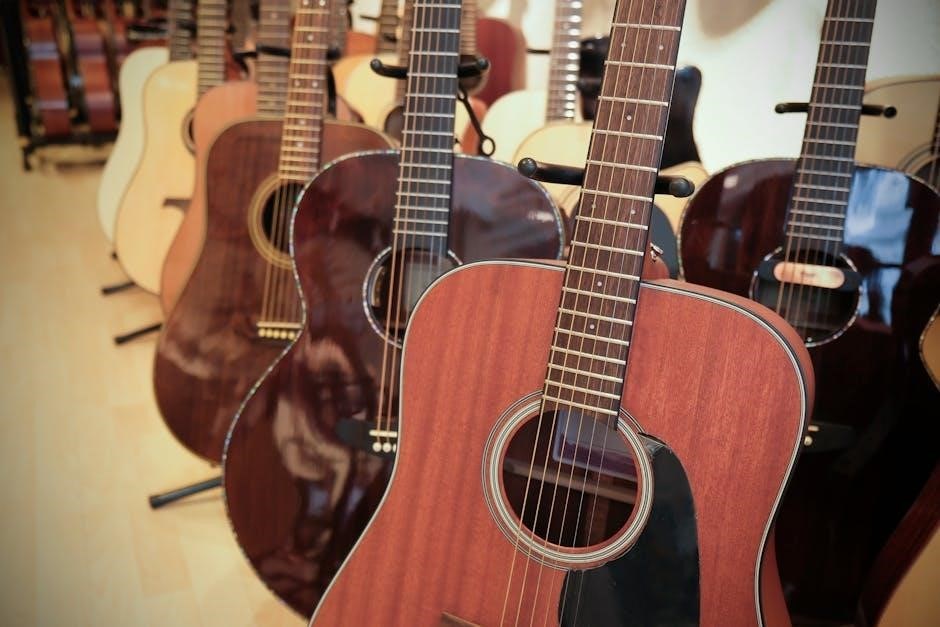
The 7-string guitar is gaining popularity, offering musicians an expanded range for diverse genres like metal and progressive rock. It’s a versatile instrument!
What is a 7-String Guitar?
A 7-string guitar, as the name suggests, features an additional string compared to the standard six-string instrument. This extra string typically extends the range lower, most commonly tuned to a low B. This expansion opens up new sonic possibilities for guitarists, allowing for deeper bass frequencies and more complex chord voicings.
While historically used in jazz and other genres, the 7-string has become particularly prominent in modern metal subgenres. It provides a broader palette for creating heavier, more intricate riffs and arrangements, appealing to musicians seeking extended range capabilities.
Why Choose a 7-String?
Choosing a 7-string guitar unlocks a wider musical landscape. The added low B string provides a substantial extension to your instrument’s range, enabling powerful bass-like riffs without needing a separate bass guitar. This is particularly beneficial for solo performers or bands seeking a fuller sound.
Furthermore, the 7-string facilitates more complex chord voicings and allows for unique melodic possibilities. It’s a compelling option for guitarists wanting to explore new creative avenues and stand out from the crowd, especially within genres like metal.
Understanding the Added String
The seventh string, typically tuned to B, dramatically expands the guitar’s tonal palette and range, offering new possibilities for composition and performance.
The Low B String: Purpose and Characteristics
The addition of the low B string fundamentally alters the guitar’s sonic landscape. It extends the instrument’s range downwards, enabling deeper, heavier riffs and bass-like tones without needing a separate bass guitar. This expanded range is particularly crucial for genres like djent, death metal, and nu-metal, where low-end frequencies are paramount.
However, the low B presents unique challenges. Its thicker gauge and lower tension require careful setup and often necessitate adjustments to the guitar’s intonation and truss rod. Players may experience a different feel and require adaptation in their playing technique to effectively utilize this extended range. Maintaining stable tuning can also be more difficult.
Tuning Options for 7-String Guitars
Beyond standard tuning (B E A D G B e), 7-string guitars offer a wealth of tuning possibilities to suit various musical styles. Drop A tuning (A E A D G B e) is popular for heavier genres, providing a crushing low end. Other options include Drop G, and various alternate tunings tailored to specific compositions.
Choosing the right tuning depends on the desired sound and playing style. Lower tunings require heavier gauge strings to maintain adequate tension and prevent floppiness. Experimentation is key to discovering tunings that inspire creativity and complement your musical vision. Careful intonation adjustments are crucial with each tuning change.
Standard Tuning vs. Drop Tuning
Standard tuning (B E A D G B e) on a 7-string provides a balanced range, ideal for chords and melodic work. Drop tuning, commonly Drop A (A E A D G B e), lowers the lowest string, creating a heavier, more aggressive tone favored in metal genres.
Drop tuning simplifies power chord shapes and facilitates lower-register riffs. However, standard tuning offers greater clarity for complex chord voicings. String gauge adjustments are vital; drop tunings necessitate heavier strings to maintain tension. Ultimately, the choice depends on the desired sonic character and playing preferences.
Guitar Types and Construction
7-string guitars come in electric and acoustic forms, each with unique construction features impacting tone and playability. Choices matter greatly!
Electric 7-String Guitars
Electric 7-string guitars are the most common type, favored for their versatility and suitability across numerous genres, particularly those demanding extended range capabilities. These instruments often feature a faster neck profile to accommodate the wider fretboard and facilitate complex techniques.
Construction typically involves mahogany, basswood, or alder bodies, paired with maple necks. Pickup configurations vary widely, from passive humbuckers delivering a thick, powerful tone to active pickups offering clarity and precision. Many models include a floating tremolo system for expressive pitch manipulation; The added string significantly expands harmonic possibilities, making them ideal for modern metal styles.
Acoustic 7-String Guitars
Acoustic 7-string guitars, while less prevalent than their electric counterparts, offer a unique sonic palette for fingerstyle players and composers. They often incorporate a larger body size to project the lower frequencies of the added low B string effectively. Construction typically utilizes traditional acoustic tonewoods like spruce for the top and mahogany or rosewood for the back and sides.
These instruments excel in jazz, folk, and Brazilian choro music, providing a richer harmonic foundation. Bracing patterns are often modified to handle the increased string tension. Finding suitable strings can be challenging, but specialized acoustic 7-string sets are available.
Body Woods and Their Impact on Tone
Body wood significantly influences a 7-string’s tonal characteristics. Mahogany delivers a warm, sustain-rich sound, ideal for heavier genres, while alder provides a balanced tone with good clarity. Basswood is lightweight and offers a neutral sound, often favored for high-gain playing.
Ash contributes brightness and resonance, enhancing articulation. Maple, frequently used as a top wood, adds snap and definition. The combination of woods impacts the overall sonic profile, affecting sustain, attack, and harmonic complexity. Careful wood selection is crucial for achieving the desired tone.
Neck Profiles and Playability
Neck profile dramatically affects a 7-string’s playability. Common profiles include “C,” “D,” and “V” shapes. A “C” shape is versatile and comfortable for most players, while a “D” shape offers a fuller grip. “V” shapes provide a vintage feel with pronounced shoulders.
Neck thickness and width also matter, influencing hand fatigue and speed. Wider necks accommodate the extra string, but require adjustment. A flatter radius enhances playability for lower tunings. Choosing the right profile is vital for comfort and performance.

Strings and Gauges
Selecting the correct strings is crucial for a 7-string. Heavier gauges are often needed to maintain tension and clarity with the added low B string.
String Gauge Considerations for 7-Strings
Choosing the right string gauge is paramount for a comfortable playing experience and optimal tone on a 7-string guitar. Standard tuning generally requires heavier gauges than a 6-string to maintain adequate tension, especially on the low B string. Lighter gauges can result in a floppy feel and intonation issues.
Many players opt for a hybrid set, combining heavier strings for the lower register and lighter strings for the higher strings. This balances tension and playability. Drop tunings necessitate even heavier gauges to prevent excessive looseness. Experimentation is key to finding the gauge that suits your playing style and desired sound.
Best String Materials for 7-String Guitars
Nickel-plated steel strings are a popular choice for 7-strings, offering a balanced tone suitable for various genres. They provide a bright, clear sound with good sustain. Stainless steel strings deliver a brighter, more aggressive tone and increased durability, ideal for heavier playing styles.
For a warmer, more mellow tone, consider pure nickel strings. These are often favored by jazz and blues players. Coated strings extend string life by resisting corrosion, but can slightly alter the tone. Ultimately, the best material depends on your tonal preferences and playing needs.
String Tension and Setup
Maintaining proper string tension is crucial for playability and intonation on a 7-string. The added low B string significantly impacts overall tension, often requiring adjustments to the truss rod to counteract neck relief. Heavier gauge strings increase tension, while lighter gauges decrease it.
A professional setup is highly recommended after string changes. This ensures optimal action, intonation, and comfortable playing. Incorrect setup can lead to buzzing, tuning instability, and difficulty bending strings. Careful attention to these details maximizes the 7-string’s potential.

Genres That Benefit from 7-String
The 7-string excels in metal subgenres like djent, death metal, and nu-metal, but also finds a home in progressive rock and jazz fusion explorations.
Metal: Djent, Death Metal, Nu-Metal
The 7-string guitar has become synonymous with modern metal, particularly within the djent, death metal, and nu-metal scenes. Its extended range allows for incredibly low, crushing riffs and complex chord voicings that are difficult, or impossible, to achieve on a standard 6-string.
Djent relies heavily on the low B string for its signature polyrhythmic, percussive sound. Death metal utilizes the extra string for deeper, more aggressive tones, while nu-metal benefits from the expanded range for creating unique textures and heavy grooves. The 7-string empowers metal guitarists to push boundaries and explore new sonic territories.
Progressive Rock and Jazz Fusion
Beyond metal, the 7-string guitar finds a home in progressive rock and jazz fusion, offering musicians expanded harmonic possibilities and a wider palette for complex compositions. The added low B string provides a solid foundation for intricate chord progressions and allows for innovative bass-like lines to be woven into the guitar parts.
Progressive artists utilize the extended range for atmospheric textures and soaring melodies, while jazz fusion players exploit it for sophisticated chord voicings and improvisational freedom. It’s a tool for sonic exploration and pushing creative limits.
Other Genres Exploring 7-String
The 7-string’s versatility extends beyond established genres, attracting musicians from diverse backgrounds eager to experiment with its unique capabilities. Increasingly, players in genres like instrumental rock and even some forms of blues are incorporating the instrument to add depth and texture to their sound.
Its extended range allows for unique arrangements and sonic landscapes, offering a fresh perspective on familiar styles. The 7-string is becoming a tool for innovation, breaking down genre boundaries and inspiring new musical expressions.
Techniques for 7-String Guitar
Mastering the 7-string involves extended range chords, advanced rhythmic approaches, and utilizing the low B string for powerful, bass-like riffs and textures.
Extended Range Chords
The seventh string unlocks a world of chordal possibilities beyond the standard guitar. Players can explore lower voicings, creating richer and more complex harmonic textures. This allows for denser arrangements and a fuller sound, particularly beneficial in genres like djent and progressive metal.
Experimenting with chord inversions and extensions becomes significantly easier with the added string. You can create unique chord shapes that are simply impossible on a six-string, opening up new avenues for songwriting and improvisation. The low B string provides a solid foundation for these expanded chords.
Consider utilizing diminished and augmented chords in lower registers for dramatic effect. The extended range also facilitates easier access to polychords, layering multiple chords simultaneously for a truly unique sonic landscape.
Advanced Rhythmic Techniques
The 7-string’s extended range empowers guitarists to execute complex rhythmic patterns with greater clarity and impact. Polyrythms, where different time signatures are layered, become more accessible and pronounced, adding a sophisticated edge to your playing. The low B string provides a powerful anchor for these intricate rhythms.
Explore syncopation and off-beat accents utilizing the lower register. This creates a groove that’s both compelling and unique. Djent, in particular, heavily relies on precise rhythmic execution, and the 7-string facilitates this style beautifully.
Experiment with palm-muting techniques on the seventh string to create percussive chugs and staccato rhythms. This adds texture and definition to your riffs, enhancing the overall rhythmic drive.
Utilizing the Low B for Bass-Like Riffs
The defining feature of the 7-string is its low B string, opening up possibilities for riffs traditionally handled by a bassist. This allows for incredibly full and powerful arrangements, especially in solo or duo settings. Create walking basslines or root-fifth patterns on the low string while layering chords above.
Experiment with octave displacement, playing the root note on the B string and its octave higher on other strings. This technique adds depth and harmonic richness to your riffs. The low B also excels at creating heavy, palm-muted power chords.
Consider using the low string for drone notes, providing a constant harmonic foundation beneath more complex melodic ideas.

Popular 7-String Guitar Models
Ibanez, Schecter, and Jackson are renowned for their quality 7-string guitars, offering diverse features and aesthetics to suit various playing styles and budgets.
Ibanez 7-String Guitars
Ibanez consistently ranks as a top choice for 7-string players, celebrated for innovation and playability. Their models, like the RG7 series, are favored in metal genres due to their thin, fast necks and powerful pickups.
Ibanez offers a wide range, from affordable entry-level options to high-end, custom-shop instruments. Many feature Wizard necks, designed for speed, and are often equipped with Floyd Rose locking tremolo systems for enhanced stability during dive bombs and extreme techniques.
Popular choices include the Prestige series, known for exceptional craftsmanship and premium components, catering to professional musicians demanding top performance.
Schecter 7-String Guitars
Schecter guitars have become increasingly popular within the 7-string community, offering a compelling blend of quality, features, and affordability. They cater to a diverse range of players, particularly those in heavier genres like djent and progressive metal.
Schecter 7-strings often boast aggressive aesthetics, powerful active pickups (like Fishman Fluence), and comfortable neck profiles. Many models feature extended scale lengths to accommodate the lower B string and maintain optimal tension.
The Schecter Solo-7 and Hellraiser C-7 are highly regarded for their playability and tonal versatility, making them excellent choices for both rhythm and lead work.
Jackson 7-String Guitars
Jackson guitars are synonymous with speed, precision, and aggressive styling, making them a natural fit for the 7-string world. They’ve long been favored by metal and hard rock guitarists seeking high-performance instruments capable of handling demanding techniques.
Jackson 7-strings typically feature fast, thin neck profiles, high-output pickups, and Floyd Rose tremolo systems for dive-bombing and expressive vibrato. Their sharp aesthetics and bold finishes appeal to players who want to make a statement.
Models like the Jackson JS Series Dinky 7 and Pro Series Soloist 7 are popular choices, offering excellent value and playability.

Setting Up Your 7-String Guitar
Proper setup is crucial for optimal playability. This involves adjusting intonation, action, and the truss rod to ensure comfortable and accurate performance.
Intonation and Action
Intonation ensures notes played on the fretboard match the open string pitch. Accurate intonation is vital for harmonic consistency across the neck, especially with the extended range. Action, or string height, impacts playability; lower action is easier but can cause buzzing, while higher action requires more force.
Adjusting the saddle position on the bridge corrects intonation. Use a tuner to check each string’s pitch at the 12th fret against the open string. Action is adjusted via the bridge saddles, raising or lowering them to find the sweet spot between comfort and clarity. A precise setup enhances the 7-string’s potential.
Truss Rod Adjustment
The truss rod counteracts string tension, maintaining the neck’s straightness. A properly adjusted truss rod prevents excessive bowing or back-bow, crucial for optimal playability and intonation on a 7-string. Adjustments are made with a specialized wrench, typically requiring small increments.
Observe the neck’s relief – the slight curve. Too much relief causes buzzing, while too little hinders action. Tightening the truss rod reduces relief, loosening increases it. Proceed cautiously, as over-adjustment can damage the neck; professional help is recommended if unsure.
Pickup Height Adjustment
Pickup height significantly impacts tone and output. Lowering pickups yields a brighter, cleaner sound with reduced volume, while raising them increases output and adds warmth, potentially introducing muddiness. Adjustments are made using screws on the pickup itself.
For a 7-string, balance is key – ensure each pickup’s height complements the others. Experiment to find the sweet spot; listen for clarity, sustain, and desired distortion levels. Start with manufacturer recommendations and fine-tune based on your playing style and amplifier.

Tuning and Maintenance
Regular tuning and care are vital for a 7-string. Consistent string changes, cleaning, and proper storage ensure optimal performance and longevity.
Using a Tuner for Accurate Tuning
Achieving precise tuning is crucial, especially with the added low B string. Utilize a reliable tuner – chromatic tuners are highly recommended for their versatility. Many smartphone apps, like GuitarTuna, offer convenient and accurate tuning capabilities for various stringed instruments.
When tuning, pluck each string individually and adjust the tuning peg until the tuner indicates the correct pitch. Be patient and make small adjustments to avoid overshooting. Remember that new strings stretch, requiring frequent retuning initially. Consistent, accurate tuning ensures a harmonious playing experience and prevents intonation issues.
String Changing on a 7-String
Replacing strings on a 7-string requires a similar process to a 6-string, but with an extra string to manage. Begin by detuning all strings completely to relieve tension. Remove the old strings one at a time, noting their placement.
Install the new strings, ensuring they are properly seated in the bridge and nut. Stretch the strings gently after tuning to improve stability and reduce slippage. Regular string changes maintain optimal tone and playability, preventing corrosion and breakage, especially with frequent use.
Regular Cleaning and Care
Maintaining your 7-string involves consistent cleaning to prevent grime buildup, which can affect tone and hardware function. Use a soft cloth to wipe down the body, neck, and strings after each playing session. Periodically clean the fretboard with a specialized fretboard conditioner to prevent drying and cracking.
Avoid harsh chemicals; instead, opt for guitar-specific cleaning products. Proper care extends the instrument’s lifespan and ensures optimal performance, preserving its value and playability for years to come.
Amplification and Effects
Choosing the right amp and effects is crucial for a 7-string, enhancing its extended range and unique tonal capabilities for optimal sound.
Choosing the Right Amplifier
Selecting an amplifier for a 7-string guitar requires careful consideration, as standard amplifiers may not fully capture the instrument’s extended low-end frequencies. Look for amps with a wide frequency response and sufficient power to handle the low B string’s demands.
High-wattage tube amps are often favored for their clarity and headroom, especially in genres like metal. Solid-state amps offer reliability and affordability, while modeling amps provide versatility with various amp simulations.
Consider amps designed for extended-range instruments, or those with a dedicated low-frequency channel. Ultimately, the best amp depends on your playing style and desired tone.
Essential Effects Pedals for 7-String
Enhancing a 7-string’s sonic capabilities often involves strategic effect pedal choices. Overdrive and distortion pedals are crucial for achieving aggressive tones in metal and rock, while ensuring clarity isn’t lost in the lower frequencies.
Chorus and flanger pedals add depth and texture, complementing the instrument’s range. Delay and reverb create atmospheric soundscapes, and a noise gate is essential for taming unwanted hum, especially with high-gain settings.
Experiment with octave pedals to further expand the tonal palette and explore unique sonic territories.
Resources for 7-String Players
Online lessons, dedicated forums, and studying notable 7-string guitarists provide invaluable learning opportunities and community support for aspiring players.
Online Lessons and Tutorials
Numerous online platforms cater specifically to 7-string guitarists, offering structured courses for all skill levels. Websites like JamPlay and TrueFire feature dedicated 7-string sections, providing lessons on technique, theory, and song tutorials.
YouTube is also a treasure trove, with channels offering free lessons and demonstrations. Search for instructors specializing in extended-range guitars to find valuable content. Many professional musicians also share their knowledge through online tutorials, offering insights into their playing styles and techniques.
Consider exploring interactive learning tools and tablature websites that support 7-string arrangements, enhancing your practice and expanding your repertoire.
Communities and Forums
Engaging with fellow 7-string players through online communities and forums is incredibly beneficial. Websites like Reddit’s r/7string and dedicated guitar forums provide spaces to ask questions, share experiences, and receive feedback.
These platforms foster a collaborative learning environment where you can discover new techniques, discuss gear, and find inspiration. Participating in discussions can accelerate your progress and broaden your understanding of the instrument.
Networking with other musicians can also lead to collaborations and opportunities to learn from diverse playing styles, enriching your musical journey.
Notable 7-String Guitarists
Exploring the work of influential 7-string guitarists provides immense inspiration and demonstrates the instrument’s capabilities. Tosin Abasi of Animals as Leaders is a pioneer, renowned for his innovative tapping techniques and complex compositions.
Jørgen Munkeby of Shining showcases the 7-string’s versatility in avant-garde metal, while John Petrucci of Dream Theater utilizes it for progressive rock mastery.
These artists push boundaries, offering unique perspectives and demonstrating the expressive potential of the extended range, encouraging aspiring players to explore their own creativity.